Your Printed Pouch Is Not Printed on the Outside
People assume the artwork on a food pouch sits on the surface, the way ink sits on a cereal box. On most laminated pouches it does not. The ink is printed on the underside of the outer film and then buried between two layers, which is why it cannot scratch off, cannot touch your product, and looks glossier than anything you could print on top. Knowing which of your bags are built that way changes what you worry about.
Overview
Ask most people where the printing on a food pouch is and they will tell you it is on the outside. It is the obvious answer. Ink goes on top of things. That is how a cereal box works, how a label works, and how almost everything else you have ever printed works.
On a laminated food pouch it is usually wrong, and the difference matters more than it sounds. The artwork on a typical printed pouch is not on the surface at all. It is sealed inside the structure, between two layers of film, where nothing can scratch it and nothing can reach it. Once you know that, several questions that worry food brands answer themselves, and one or two things you did not worry about turn out to deserve attention.
Where the Ink Actually Is
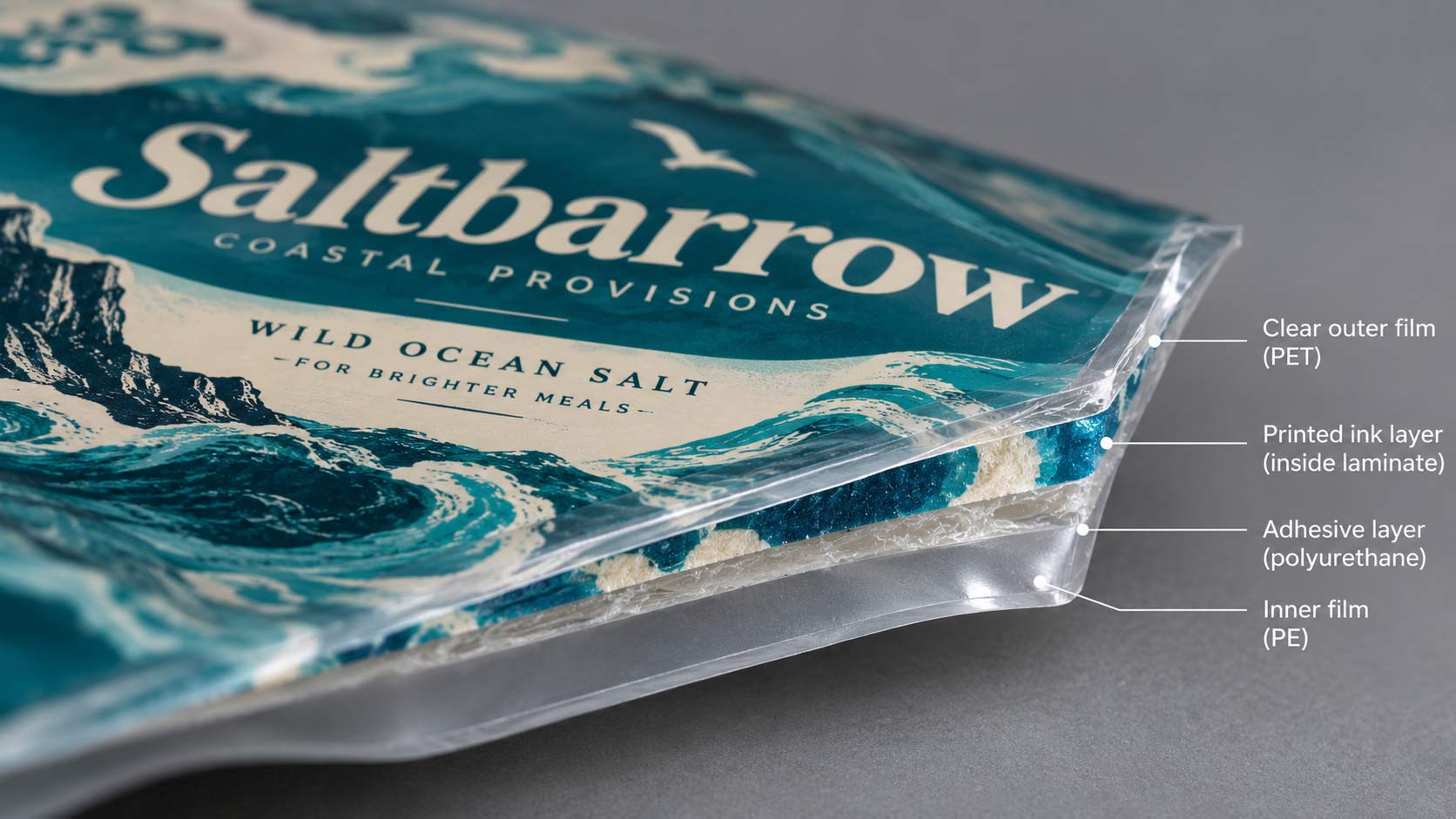
A laminated pouch is at least two films bonded together with adhesive. Call them the outer film, the one you look at, and the inner film, the one your product touches.
In reverse printing, the press prints the artwork onto the underside of that outer film. The image is laid down mirrored, because it is going to be viewed through the film rather than from the ink side. Then the printed film is laminated to the inner film, with the ink facing inward. When it is finished, the ink is not on either exposed face of the bag. It is in the middle, sandwiched between the outer film above it and the laminating adhesive and inner film below it.
That is why your pouch has that deep, glassy look. You are not looking at ink. You are looking through a clear film at ink behind it, which is a different and better-looking thing.
Why It Is Done This Way
Burying the ink solves several problems at once, which is why it became the default for laminated packaging.
- It cannot scuff. Nothing abrades print that is under a layer of film. Bags can rub against each other in a case all day without marking.
- It cannot be scratched off by a fingernail, a box cutter edge, or a pallet corner.
- It never contacts the product. The ink is physically separated from the inside of the bag by an entire film layer.
- It looks better. Viewing ink through clear film gives depth and gloss that surface printing has to chase with coatings.
- It survives moisture and handling. A wet or greasy bag is still a legible bag.
That last point is worth sitting with. A surface printed package that gets handled hard, chilled, or wiped down will eventually show it. A reverse printed one will not, because there is nothing exposed to wear.
When a Bag Is Surface Printed Instead
Reverse printing needs a clear outer film to look through. When there is not one, the ink has to go on top, and the rules change.
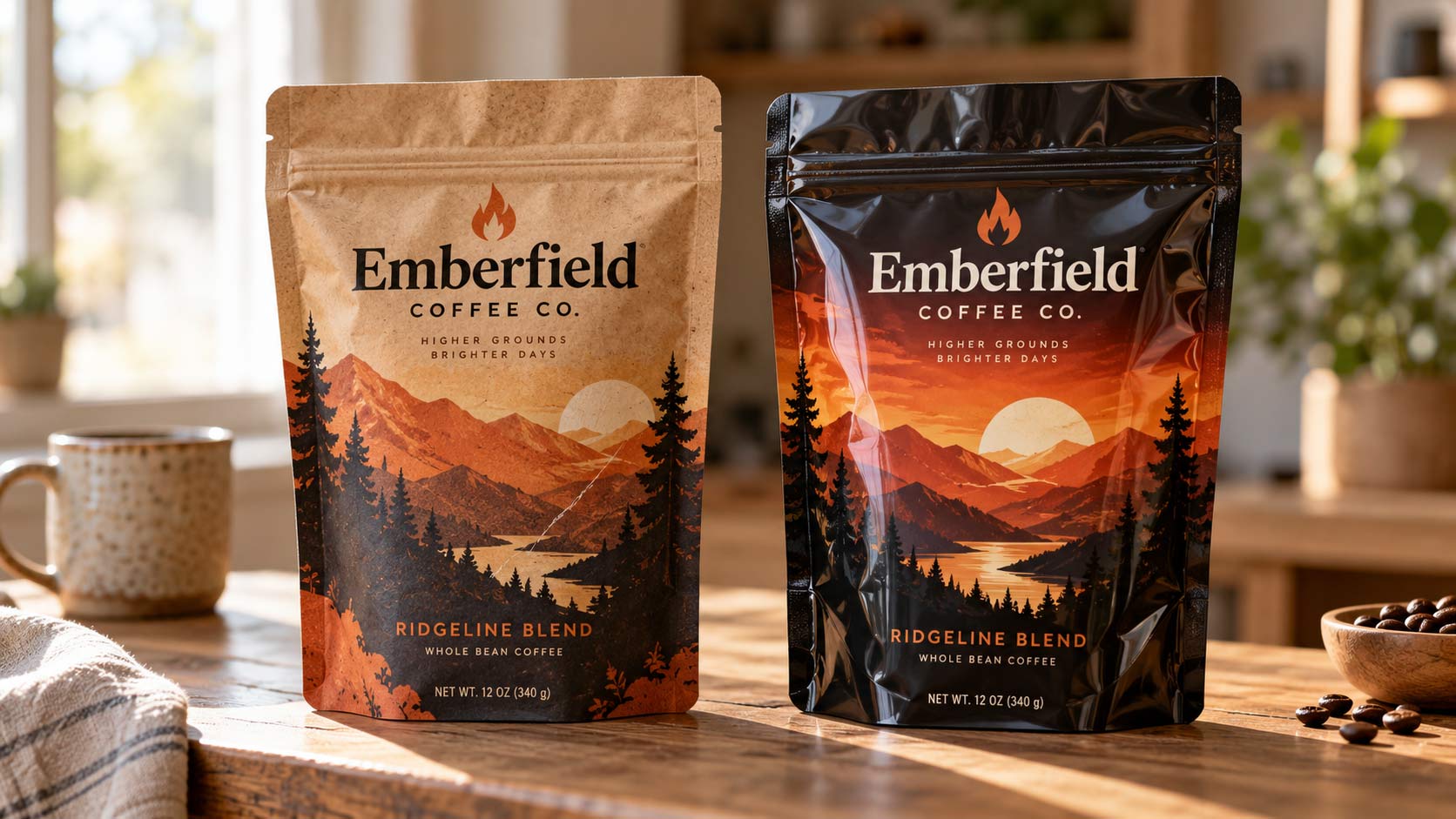
Kraft paper pouches are the common case. You cannot see through paper, so the artwork is printed on the outside face, sitting exposed on the surface. The same is true of plain paper bags, many corrugated boxes, and most applied labels. These are not worse choices, they are different ones, and plenty of brands pick kraft precisely because it looks honest and natural. But a surface printed bag can scuff, and it behaves differently under ink, which is the subject of our post on white ink on kraft. If your packaging is kraft, surface abrasion is a real thing to plan for, especially with dark solid colors that show every mark.
The useful habit is simply knowing which of your packages is which. Most brands run both and have never been told there is a difference.
What This Actually Means for Food Safety
This is the question that sends people looking in the first place, so it deserves a straight answer rather than a reassuring one.
In a reverse printed laminate, the ink is not in contact with your food. There is a complete film layer between the two. That removes the specific worry most people have, which is printing touching the product. What it does not do is make the rest of the structure irrelevant. The layer that does touch your food is a separate film chosen for that job, and it is the one that has to be rated for direct food contact. That is a specification question about the whole structure, not a question about the ink.
So the right thing to ask a supplier is not whether the ink is safe. It is whether the full structure, including the food contact layer and the adhesives, is specified and documented for your product type. A good supplier will answer that without hesitating. If you are putting together a new custom food packaging program, get that confirmation in writing at the specification stage rather than after the first run.
What It Means for Your Artwork
Reverse printing changes a few practical things on the production side, and none of them are your problem to solve, but they are worth recognizing.
The file is printed mirrored, so anything that reads correctly on your screen is flipped on press and flipped back by being viewed through the film. The order of the layers inverts too, which matters most for white: on a reverse printed job the opaque white goes down last, behind everything else, acting as a backing rather than a base. That is the same white layer that does the work on kraft, just arriving from the other direction. Your prepress team handles all of this, but it explains why a packaging printer asks for files differently than a sign shop does.
What to Ask For
A short list that covers almost everything worth knowing about your own packaging.
- Is this structure reverse printed or surface printed?
- What is the food contact layer, and is it documented for direct contact with my product?
- If it is surface printed, what protects the ink from abrasion?
- Will this structure be run digitally or on rotogravure, and does that change the build?
None of these are difficult questions, and the answers tend to clarify a lot at once. Our comparison of digital versus rotogravure printing covers how the method interacts with run size, which is usually the next thing people want to know.
Wrapping It Up: Look Through the Bag, Not At It
The reason this is worth five minutes of your attention is that it quietly resolves a worry a lot of food brands carry around. The ink on a laminated pouch is not sitting on a surface waiting to rub off into a case of product or onto someone's hands. It is encased in the structure, which is both why it looks so good and why it survives everything you put it through.
The real questions move one layer deeper, to what your product actually touches and whether that film is specified for it. That is a conversation worth having properly with whoever makes your packaging. And if you also run kraft, remember it plays by the opposite rules, with the ink exposed on the surface where abrasion and substrate color both get a vote. Two kinds of bag, two sets of concerns, and it takes about ten seconds to tell which one you are holding.
Ready to Create Packaging That Elevates Your Brand?
Let's bring your product to life on the shelf.
Get a Free Quote