Cookie and Bakery Packaging: How to Keep Baked Goods Fresh, Whole, and on the Shelf
Baked goods are some of the hardest products to package well. They go stale fast, they crush easily, they stain their own bags with butter, and they sell almost entirely on how they look. The right package has to solve all four at once, and the trick is that crisp and soft want opposite things.
Overview
Baked goods are some of the hardest products to package well, and most brands underestimate it until the reviews start. A cookie that was perfect leaving the kitchen arrives soft, or stale, or broken in half, or sitting in a bag with a grease ring that makes it look old. None of that is the baker's fault. It is the package doing too little.
Good bakery packaging has to do four jobs at once: hold texture, slow staling, protect the shape, and make the product look as good as it tastes. The catch that makes it tricky is that crisp baked goods and soft baked goods want opposite things from their packaging, so there is no single right answer. This guide walks through what actually goes wrong, how to match the package to the product, and where a pouch wins versus where a box earns its cost.
What Actually Ruins a Baked Good
Four things degrade a baked good on the way to the customer, and a good package is really just a defense against all four.
- Moisture, in both directions. A crisp cookie goes soft when it pulls in humidity. A soft cookie goes hard and dry when it loses its own moisture. Same enemy, opposite direction.
- Crushing. Cookies, crackers, and pastries are brittle, and a bag offers almost no structure against a stack of other boxes or a rough delivery.
- Grease. Butter and oil migrate out of rich baked goods into the packaging, where they show as dark stains and make even a fresh product look stale.
- Staling and stale air. Beyond moisture, baked goods go flat as they lose aroma and react with oxygen, so a bag full of air ages the product faster than a snug one.
Almost every bakery packaging decision is a trade between these four, and the first fork in the road is the big one: is your product crisp or soft?
Crisp Wants Dry, Soft Wants Sealed
This is the rule that trips up new bakery brands, so it is worth stating plainly.
A crisp product, like a thin cookie, a biscotti, or a cracker, fails when moisture gets in. It wants a high-barrier film that keeps humidity out, and it often wants to be sealed with as little air as possible so it stays snappy. Our post on why snacks go soft in the bag digs into the moisture side of this in detail, and the same physics applies to a crisp cookie.
A soft product, like a brownie, a muffin, or a chewy cookie, fails the other way. It wants to keep its own moisture in, which also means a good barrier, but now the risk is that trapped moisture plus time equals mold. Soft baked goods usually need a shorter shelf life, sometimes a moisture-absorbing or ventilated approach, and honest date labels rather than a promise the package cannot keep.
The reason this matters is that the same bag is right for one and wrong for the other. Before you pick a format, decide which failure you are fighting, because it changes the film, the seal, and even whether a window is a good idea.
When a Pouch Is the Right Call
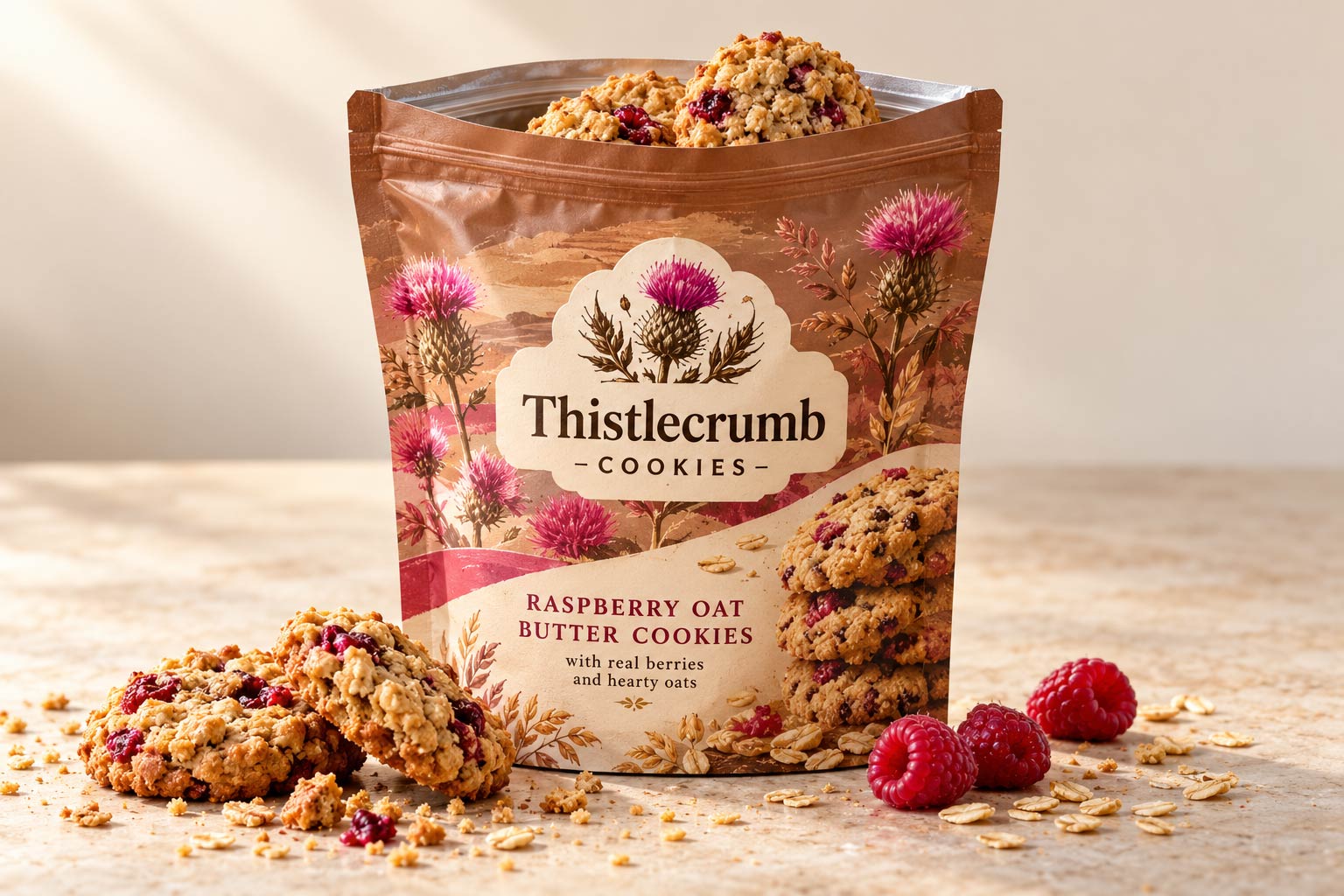
For most cookies, crackers, biscotti, and grab-bag baked goods, a printed flexible pouch is the workhorse, and it is usually the most cost-effective way to get a strong barrier and a premium printed look in one package.
A stand-up pouch sits up on a shelf and gives you a big branded front. A flat-bottom pouch does the same with more structure and a flat base for stability. A pillow bag is the cheapest for lightweight, high-volume items. Add a resealable zipper and a multi-serve bag of cookies stays fresh after the first open, which matters more than brands expect, because a bag that will not reclose is the single most common bakery complaint. Our post on why zippers stop resealing is worth reading if your product is crumbly or buttery, since those are exactly the crumbs that jam a track. For a brand still testing recipes, stock bags with a label let you get to market fast, and a move to custom food and product packaging gives you the full printed bag once the lineup is set.
When a Box Earns Its Place
Some baked goods are too delicate or too premium for a bag, and that is where a printed box stops being an upgrade and becomes the actual answer.
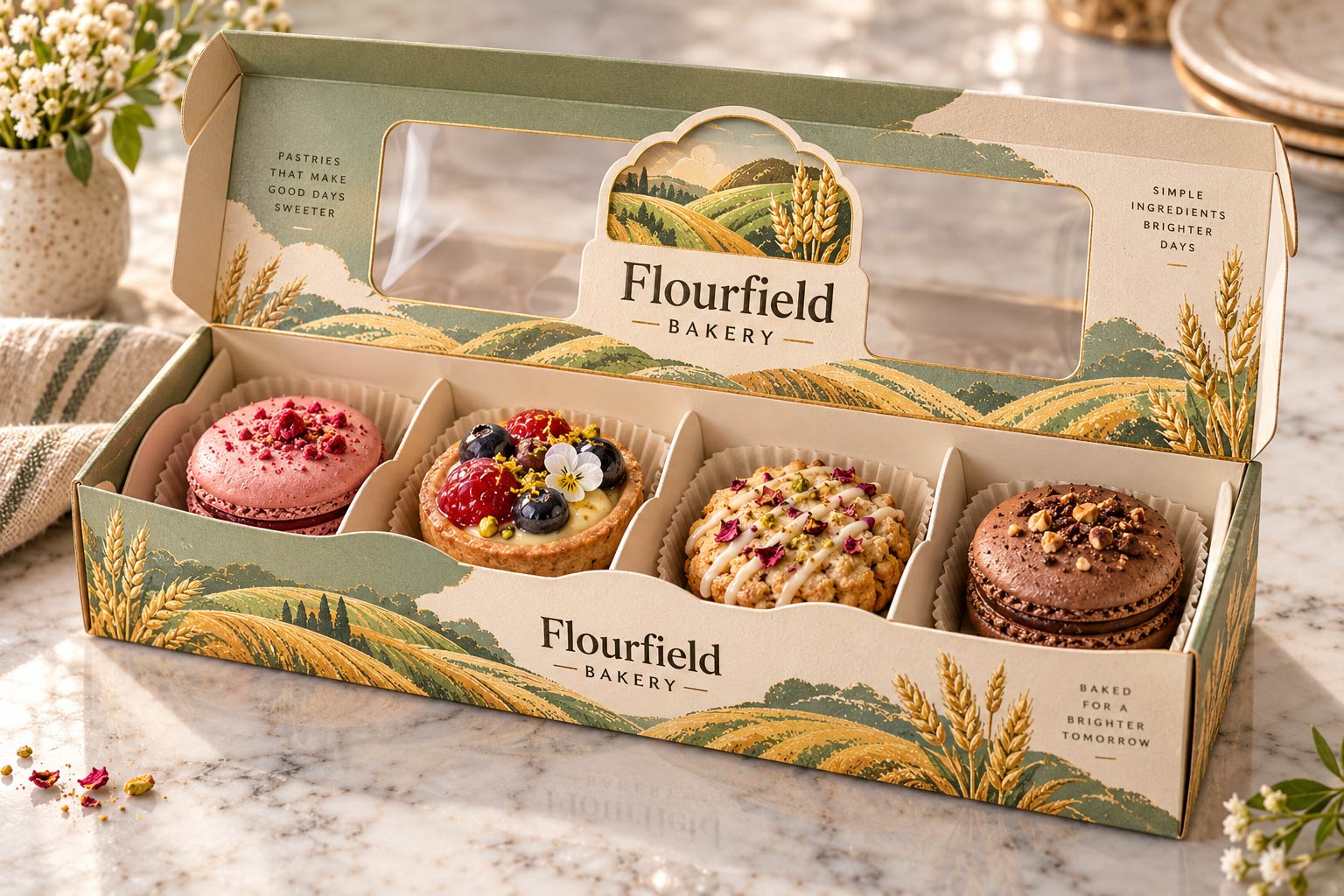
Macarons, cupcakes, layer-cake slices, decorated cookies, and pastries all share a problem: they cannot take any pressure at all, and a bag gives them none. A rigid or folding carton gives the product its own protected space, holds its shape through shipping, and reads as a gift the moment a customer sees it. For anything sold as a set, a holiday assortment, or a premium single item, a custom box or mailer is usually what separates a product that survives the trip from one that arrives as crumbs. Boxes also carry inserts and dividers, so each piece travels in its own pocket instead of knocking against its neighbors.
The Window Problem
A clear window sells baked goods better than almost anything, because people buy with their eyes and a cookie looks like a cookie through a window. But a window is a hole in your barrier, and it is worth being honest about the cost.
A window lets light in, and light speeds up staling and can fade or dull the product over time. It is also a weaker point for moisture than the surrounding film. That does not mean avoid windows, it means size them deliberately: a smaller window still sells the product while limiting the exposure, and for a crisp product on a longer shelf life you may want to skip it entirely. We wrote a whole post on this trade, your clear window is selling the product and shortening its life, because it is the one place bakery brands most often over-commit.
Grease Is the Quiet Killer
The problem nobody plans for is fat. Butter, oils, and chocolate migrate out of a rich baked good and into the packaging, and on paper or uncoated board they show up as dark, translucent stains that make a fresh product look old and poorly made.
The fix is a grease-resistant liner or film, or a laminated structure that keeps the fat from reaching the printed surface. If you are selling anything buttery, shortbread, croissants, chocolate-heavy cookies, you want to raise grease resistance at the same time you choose the format, not after you see the first stained box come back. It is a material decision, and it is far cheaper to spec up front than to rebrand around a stain.
Shipping Baked Goods Without the Heartbreak
Direct-to-consumer bakery is booming, and it is also where the most product dies in transit. A bag that is fine on a shelf is defenseless in a shipping box bouncing across the country.
For ecommerce, the package has to do three things: give the product rigidity so it is not crushed, immobilize it so it is not rattling around, and be right-sized so there is no empty space to collapse into. That usually means a sturdier carton, inserts or a snug fit, and sometimes an outer mailer around an inner retail box. Thinking about the unboxing is not just branding here, it is survival, because a beautiful cookie that arrives broken generates a refund and a bad review at the same time.
Small Batch and Low Minimums
A lot of bakery brands start in a home kitchen or a single storefront, and they assume custom packaging is out of reach until they are much bigger. It is not.
With digital printing you can get fully custom printed bags at a low minimum, which lets a small bakery put real branding on the shelf without ordering tens of thousands of units. You can test a seasonal cookie, print a short run, and reprint only what sells. Pair that with sustainable packaging options like recyclable or compostable films and kraft board, which the bakery customer in particular tends to care about, and a small brand can look established and responsible from its very first order.
Wrapping It Up: Match the Package to the Bake
Bakery packaging is really one question asked four ways: will it stay fresh, will it stay whole, will it stay clean, and will it still look delicious when the customer sees it. The reason it feels hard is that crisp and soft products answer those questions in opposite directions, so the package that saves one would ruin the other.
Start by deciding whether you are protecting crispness or softness, pick a pouch for grab-and-go and a box for anything delicate or premium, size your window to the shelf life rather than the temptation, spec grease resistance before it stains, and build for the shipping trip if you sell online. Do that, and the package disappears into the experience, which is exactly what a good one should do: let the customer think only about the cookie.
Ready to Create Packaging That Elevates Your Brand?
Let's bring your product to life on the shelf.
Get a Free Quote