
The Tear Goes Sideways Because Film Has a Grain
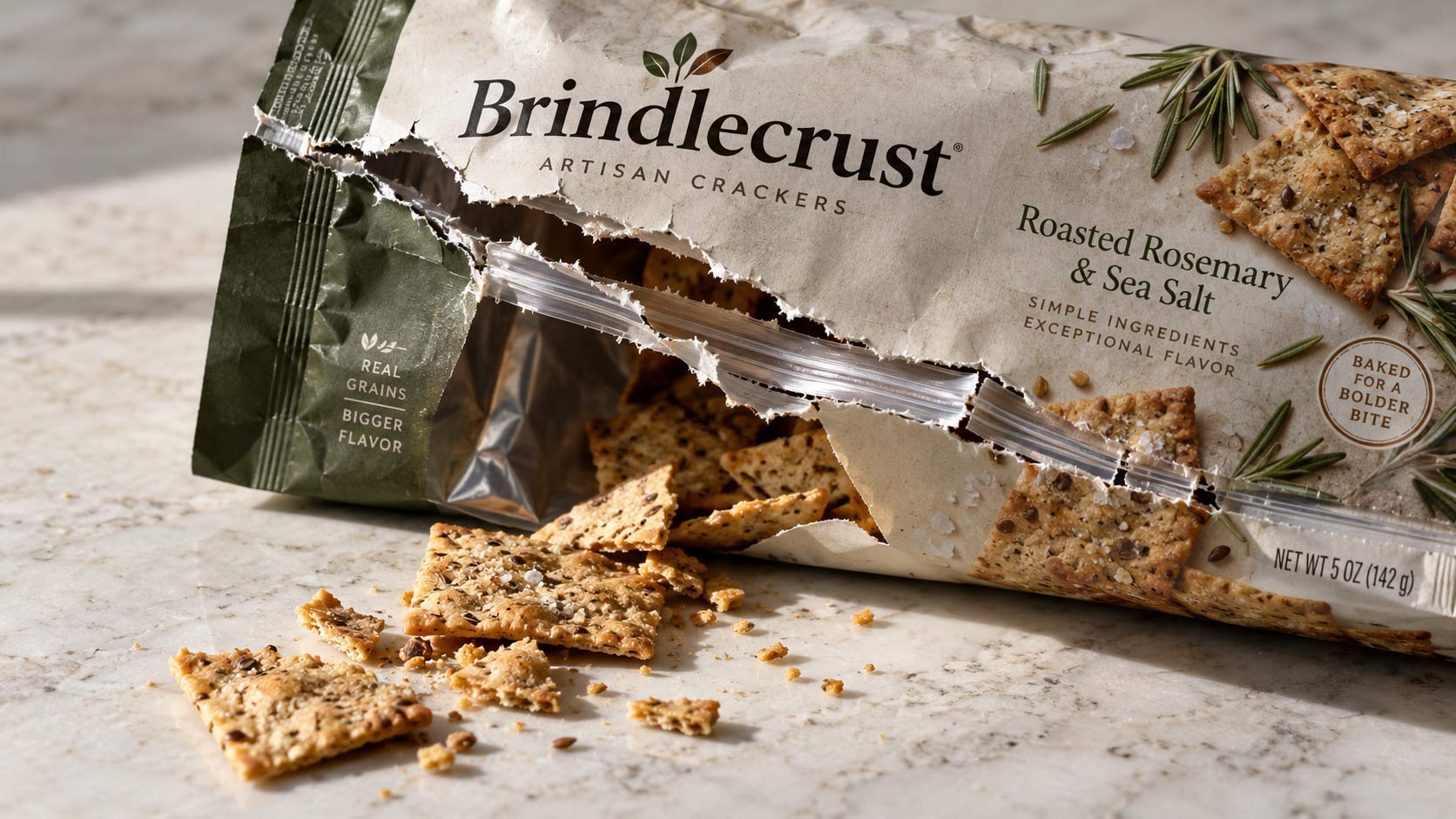
A customer pulls the tear notch and the tear curves down into the bag instead of running across it. Product everywhere, and a one star review about cheap packaging. The notch is usually fine. Packaging film is oriented during manufacture, so it tears cleanly in one direction and fights you in the other, and a notch placed against that grain will never give a straight tear no matter how well it is cut.
Overview
The complaint arrives through customer service rather than quality control, which is part of why it takes so long to diagnose. Somebody opened a pouch the way the little notch invited them to, and instead of a clean line across the top the tear dived downward into the bag. Half the product went on the counter. The review says the packaging is cheap.
The instinct is to look at the notch. Was it cut deep enough, was it the right shape, did the die drift. Usually the notch is exactly as specified and cut perfectly well. The problem is not the notch at all, it is the direction the notch is pointing, because packaging film is not the same material in every direction and a tear will always try to follow the easy path.
Film Is Not the Same in Every Direction
This is the fact the whole thing rests on, and it is invisible in every spec sheet you will read.
When film is manufactured it is stretched, deliberately, while the plastic is soft. That stretching pulls the long polymer chains into rough alignment rather than leaving them as a random tangle. It is what gives the film its strength, its clarity and its stiffness, and it is why packaging film performs so much better than a simple unoriented sheet of the same plastic.
It also has a consequence. A material with aligned chains behaves differently depending on which way you pull it. Along the direction the chains run, a tear can travel between them easily and in a straight line. Across them, the tear has to break through chain after chain, so it resists, then gives way somewhere unpredictable, then wanders. Wood splits cleanly along the grain and tears raggedly across it for the same underlying reason.
Film has a grain. Nobody calls it that on a drawing, but your customer finds it every time they open a bag.
Machine Direction and Cross Direction
The two directions have names, and knowing them is most of the battle.
The machine direction is the way the film travelled as it was made, the direction it unwound along the length of the roll. The cross direction is across the web, perpendicular to that. Tear behavior differs between the two, and which one tears more cleanly depends on the specific film and how it was oriented during manufacture.
What matters for you is that once a bag is formed, those two directions sit in a fixed, known orientation relative to the bag. A pouch made one way has the machine direction running up and down the bag. A different format has it running side to side. It is entirely predictable, it is determined by how the bag was converted, and the people who made your bag know exactly which way it runs.
That means a tear notch can be placed to work with the grain or against it, and that choice is made at the dieline stage.
What Goes Wrong When They Disagree
When the notch points across the grain rather than along it, the failure is consistent rather than occasional, which is a useful diagnostic in itself.
- The tear starts and immediately curves, usually downward into the body of the bag.
- It takes more force than it should, so people end up yanking, which makes the curve worse.
- The result is jagged rather than a clean edge, so the pack looks damaged even when nothing spilled.
- A resealable zipper below the notch gets torn through, which turns a reusable bag into a single use one.
- It happens on nearly every bag, not randomly, because it is geometry rather than a defect.
That last point is the tell. A manufacturing fault gives you scattered failures. A grain problem gives you a failure rate close to one hundred percent, which is exactly the pattern people misread as "this whole batch is bad."
Why It Reads as a Bad Notch
Everything about the symptom points at the notch, which is the one part of the system that is visible.
The notch is right there at the top of the bag, it is the thing the customer interacted with, and it is small and easy to blame. Meanwhile the actual cause is a property of the film that has no visual signature at all. You cannot look at a bag and see which way the grain runs. You can only infer it from how the bag behaves, and by then the pack is open.
It also survives inspection. A bag with a badly oriented notch passes every check you would normally run, because the bag itself is made correctly. The flaw only appears in the hands of somebody opening it.
Designing So the Tear Runs Straight
All of this is settled before anything is printed, and it costs nothing to get right.
- Ask which way the machine direction runs in your chosen format. It is a one sentence answer and it determines everything else.
- Place the notch so the tear runs with the grain, across the bag rather than into it.
- Use laser scoring if you need a guaranteed path. A scored line gives the tear a route to follow regardless of grain, which is how packs with complex opening features stay predictable.
- Keep the tear line clear of the zipper. Even a straight tear ruins a reseal if it is at the wrong height.
- Test on real production bags. Hand made samples are often converted differently, so they can tear beautifully while production does not. This matters most on snack and chip packaging, where the notch is the only way in.
If you are specifying a new format, raise opening behavior at the same time as the closure, since they interact. Our post on why zippers stop resealing covers the other half of that conversation, and a full custom food packaging spec is where notch placement gets decided along with everything else.

It Explains More Than Just Tearing
Once you know film has a grain, a few other behaviors stop being mysterious.
Bags that split in transit often split along one consistent axis rather than randomly, because that is the direction the film gives way most easily. That is worth reading alongside what road vibration does to a barrier, since both are the same idea of the film having preferred failure paths. A pouch stretches noticeably more one way than the other when you pull it. Wrinkles and creases tend to form in a consistent orientation. None of these are faults. They are the same underlying property showing up in different situations, and recognizing it saves you from chasing a defect that is actually just material behavior.
It is also a reason to be careful comparing one supplier's bag to another's. Two bags that look identical can tear completely differently if the film was oriented differently or the format puts the grain another way round.
Wrapping It Up: Point the Notch the Right Way
A tear notch is one of the smallest features on a package and one of the most emotionally loaded, because it is the exact moment a customer physically interacts with your brand. When it works, nobody thinks about it. When it fails, they think about it while cleaning up.
The fix is not a better notch, it is a notch pointed in the direction the film already wants to tear. Ask which way the machine direction runs in your format, place the notch to work with it, consider laser scoring when the opening has to be exact, and test on bags that came off the real line. Get that right once at the dieline stage and every bag you ship afterward opens the way you intended.


Ready to Create Packaging That Elevates Your Brand?
Let's bring your product to life on the shelf.
Get a Free Quote